Turbo Blower vs Roots Blower: Which Is Better for Aeration?
Release time: Jun.11.2026
Click volume: Views
The Aeration Dilemma: Dynamic vs. Positive Displacement
In municipal and industrial wastewater treatment plants (WWTP), the aeration basin is the single largest consumer of electricity, often accounting for 50% to 70% of a facility's total energy bill. The aeration blower runs continuously to supply dissolved oxygen to microorganisms that break down organic waste.
Choosing between a High-Speed Turbo Blower (such as a magnetic or air-suspension turbo) and a traditional Rotary Lobe Roots Blower is one of the most critical design decisions an environmental engineer or plant manager must make. The choice is not about finding which machine is universally "better," but rather matching the specific physics of the aeration basin with the correct thermodynamic operating principle.
1. Core Technologies and Operating Principles
The fundamental difference between these two machines lies in how they compress and move air: dynamic acceleration versus mechanical trapping.
Roots Blowers (Positive Displacement)
A Roots blower utilizes a pair of meshing twin or triple-lobe rotors rotating synchronously inside a closed casing. As the lobes rotate, they trap a fixed volume of ambient air at the inlet, carry it around the perimeter of the housing, and physically force it out into the discharge piping against the water's backpressure.
Because it is a positive displacement machine, its volumetric flow rate remains relatively constant even if the water depth fluctuates. It relies on tight m
echanical clearances and runs at relatively low rotational speeds.
Turbo Blowers (Dynamic Centrifugal)
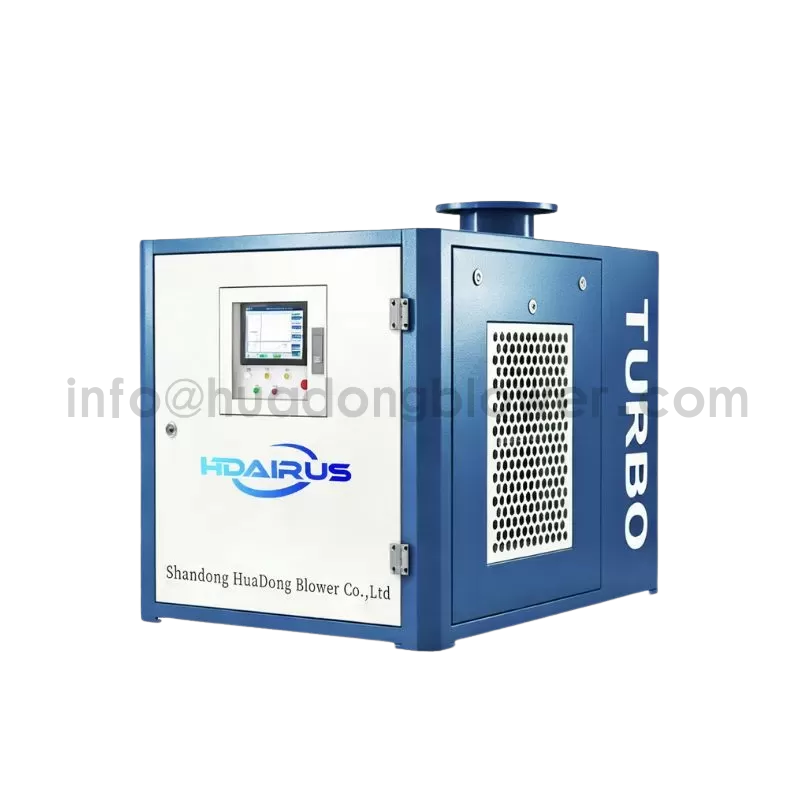
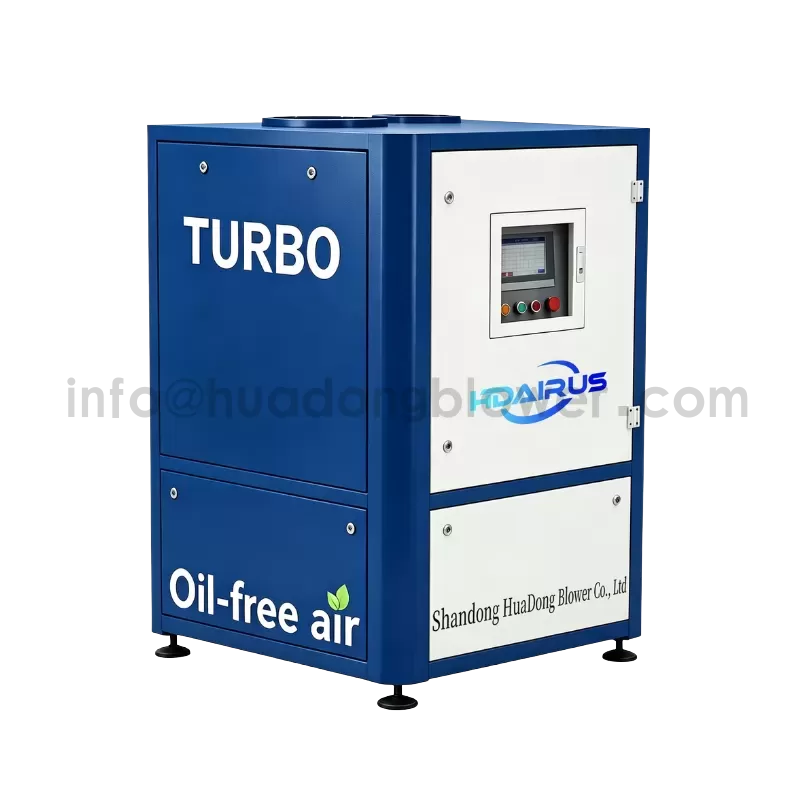
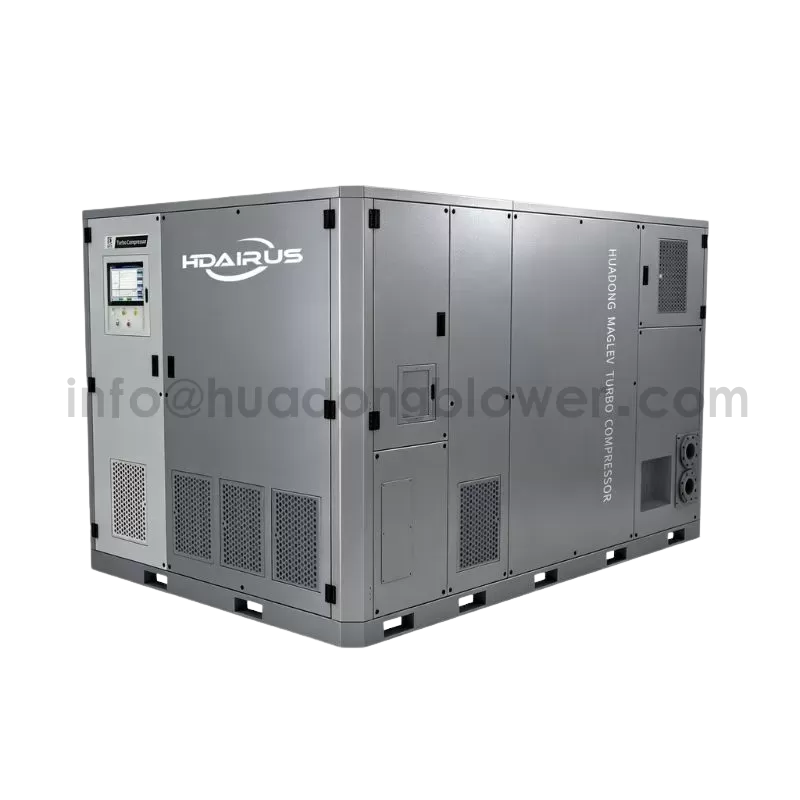
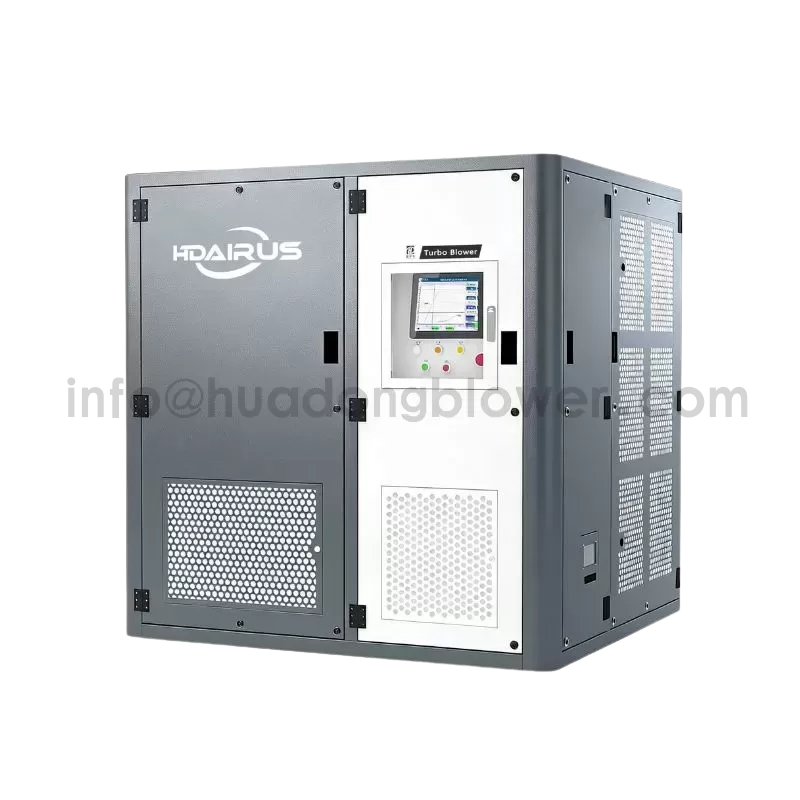
A turbo blower is a dynamic centrifugal machine that uses a high-speed impeller to impart kinetic energy to the air stream. A permanent magnet motor spins the impeller at tens of thousands of revolutions per minute (RPM). Ambient air enters the center of the spinning impeller, is accelerated outward at high velocity by centrifugal force, and passes through a diffuser section. The diffuser slows the air down, converting high kinetic velocity into static pressure.
To achieve these ultra-high speeds efficiently, modern turbo blowers utilize contactless air-suspension or magnetic bearings, eliminating mechanical friction entirely.
2. Energy Efficiency and Operational Economics
Because aeration basins operate 24/7, even a small percentage difference in blower efficiency translates to massive variances in annual factory utility bills.
Roots Blower Efficiency Profile: Traditional Roots blowers lose energy due to internal mechanical friction in gears, bearings, and oil seals, as well as minor internal air slippage (backstreaming). Their average polytropic efficiency generally sits between 50% and 65%. They are less efficient at peak flows but hold a highly stable efficiency curve across a wide pressure spectrum.
Turbo Blower Efficiency Profile: By eliminating mechanical gearboxes and physical bearing contact, high-speed turbo blowers achieve exceptional thermodynamic efficiency, often reaching 75% to 85%. Upgrading an old aeration basin from a standard Roots blower to a magnetic or air-suspension turbo blower typically slashes electricity consumption by 20% to 40%.
3. Flow Turndown and Water Depth Adaptability
Aeration basins are highly dynamic environments. Biological oxygen demand (BOD) changes based on wastewater influx rates throughout the day, and water levels can shift during heavy rain or sequential batch processing.
Water Depth Fluctuates ──► Roots Blower ──► Constant Airflow, Scales Pressure Automatically
Water Depth Fluctuates ──► Turbo Blower ──► Vulnerable to Surge if Pressure Exceeds Impeller Limit
Roots Blower Flexibility: Positive displacement blowers excel at handling variable backpressures. If the water level in the aeration basin rises from 4 meters to 6 meters, the Roots blower continues to deliver almost exactly the same volume of air, naturally drawing more motor horsepower to overcome the higher resistance. Furthermore, when paired with a Variable Frequency Drive (VFD), a Roots blower offers a wide flow turndown range (typically 30% to 100%) without operational instability.
Turbo Blower Boundaries: Centrifugal machines are highly sensitive to pressure variations. A turbo blower must operate within a strict aerodynamic envelope. If the system pressure rises unexpectedly beyond the impeller's design limit, the blower can experience a dangerous phenomenon known as surge (where air flows backward through the impeller, causing violent vibrations and potential software shutdowns). While its efficiency is superior at its design point, a turbo blower’s effective flow turndown range is narrower (typically 50% to 100%).
4. Maintenance, Maintenance Footprint, and Acoustic Impact
The day-to-day physical management of the blower room impacts factory labor allocation and operator safety.
Roots Blower Maintenance: Standard Roots blowers require routine maintenance schedules. Operators must perform regular oil changes for the synchronization gears, grease bearings, check drive belt tension, and replace mechanical shaft seals. Additionally, because they emit high-amplitude, low-frequency pulsations, Roots blowers generate heavy noise levels, requiring thick acoustic enclosures and heavy concrete dampening foundations.
Turbo Blower Maintenance: Because the rotating assemblies in modern air-bearing or magnetic turbo blowers float completely in the air or a magnetic field, there is zero physical contact, zero wear, and zero lubricating oil inside the machine. Maintenance is reduced exclusively to swapping out the ambient air intake filters every few months. Furthermore, turbo blowers produce a smooth, high-frequency hum that is easily managed by standard cabinetry, operating at low noise levels with minimal vibration.
Engineering Selection Matrix for Aeration Basins
Selection Parameter | Roots Blower (Positive Displacement) | Turbo Blower (Dynamic Centrifugal) |
Ideal Application Scale | Small to Medium plants; Shallow basins | Medium to Large regional plants; Deep tanks |
Thermodynamic Efficiency | Moderate (50% – 65%) | Excellent (75% – 85%) |
Sensitivity to Water Depth | Immune; automatically scales pressure | High; requires tight pressure-matching to avoid surge |
Turndown Flow Capability | Wide (30% – 100%) | Moderate (50% – 100%) |
Lubrication & Oil Risks | Requires oil sumps; potential seal leaks | 100% Oil-free design |
Maintenance Profile | High; oil changes, seals, belts, bearings | Very low; air filter replacements only |
Acoustic & Vibration Impact | High vibration; loud low-frequency thumping | Zero vibration; quiet high-frequency hum |

Recommended Products